A Tender New Milestone Begins
Your baby’s first tooth is a beautiful and emotional milestone — but the days leading up to it can feel confusing, exhausting, and overwhelming. Fussiness spikes, sleep changes, and suddenly everything goes into your baby’s mouth.
Many parents wonder:
- “Is this really teething?”
- “Why is my baby so unsettled?”
- “Should I be worried about fever or diarrhoea?”
This comprehensive, parent-friendly handbook brings you clarity, reassurance, and scientifically accurate guidance, based on international pediatric dental standards.
Here’s what you’ll learn: ✨ Real signs of teething ✨ What actually helps (and what doesn’t) ✨ Safe pain-relief strategies ✨ When to worry ✨ A complete baby tooth eruption chart ✨ Rare situations like natal & neonatal teeth
What Exactly Is Teething, and Why Does It Happen?
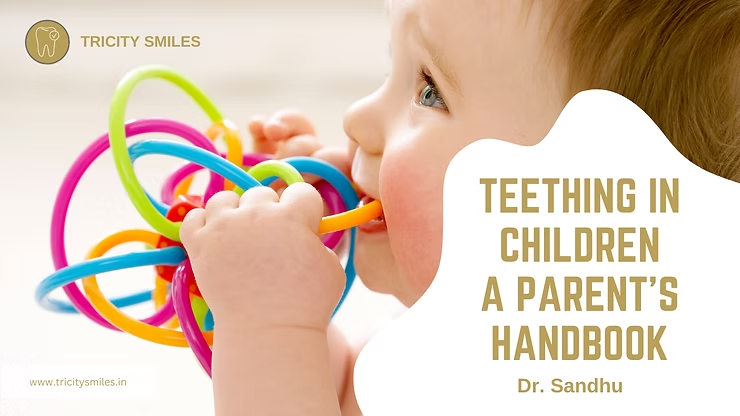
Teething is the natural process of baby teeth moving upward and breaking through the gum surface. This usually begins between 4–7 months, though it can be earlier or later leading to temporary discomfort but not illness. 1
The first teeth to erupt are usually the lower central incisors, followed by upper incisors, lateral incisors, first molars, canines, and finally second molars.²
🧪 What causes the discomfort?
As the tooth migrates through the gums, it triggers:
- Mild inflammation
- Increased saliva
- A strong desire to chew
- Sensitivity around the gums
🌡 Important: Teething does not cause high fever, diarrhoea, vomiting, or respiratory symptoms. These require medical evaluation.3
🦷 Order of Baby Tooth Eruption
From earliest to latest:
- Lower central incisors
- Upper central incisors
- Upper & lower lateral incisors
- First molars
- Canines
- Second molars
Understanding this sequence helps parents know what to expect next.
What Are the Real Symptoms of Teething?
Many things get blamed on teething, but only some symptoms are clinically supported.
✔️ Normal Teething Symptoms
(Backed by ADA, AAPD & systematic reviews) 4-6
- Excessive drooling 💧
- Mild gum tenderness or swelling
- Increased chewing / biting desire
- Irritability / crankiness
- Slight temperature rise (not above 38°C)
- Mild sleep disturbance
- Increased sucking
- Slight decrease in appetite
These symptoms rise and fall as each tooth comes in.
⚠️ Warning Signs NOT Caused by Teething
Seek medical help for:
- Fever ≥ 38°C (100.4°F)
- Persistent diarrhoea
- Vomiting
- Widespread rash or hives
- Extreme lethargy
- Difficulty breathing
- Poor feeding
These symptoms suggest infection or illness, not teething.
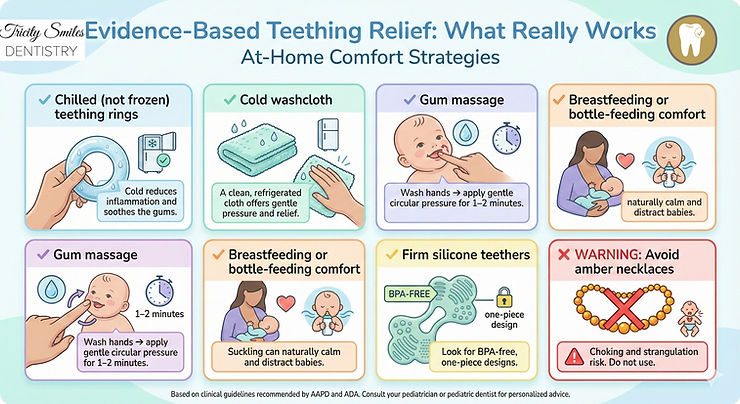
Evidence-Based Teething Relief: What Really Works
Professional Dental Support at Tricity Smiles Dentistry
✔️ First dental visit by age 1
Recommended by ADA, AAP, and AAPD for early detection of eruption delays, anomalies, or decay.7
✔️ Personalized teething care
We help parents choose safe teethers, understand eruption timelines, and avoid harmful remedies.
✔️ Monitoring for delayed eruption
We evaluate if:
- No teeth by 12 months
- Fewer than 4 teeth by 18 months
- Eruption is asymmetric
- There are concerns about trauma or developmental issues
✨ Early exams prevent more significant dental problems later in life.
Medication Guide: What’s Safe for Teething Pain?
✔️ Safe Options (Always follow pediatric dosing)
- Paracetamol (Acetaminophen)
- Ibuprofen
These help reduce pain and irritability when discomfort is significant. Contact a pediatric dentist to get the safe dosage for your child.
⚠️ Avoid These Products
- Benzocaine gels (FDA warns of risk of methemoglobinemia) 8
- Lidocaine
- Homeopathic teething tablets (FDA recalls for safety concerns)
- Teething bracelets/necklaces ( strangulation/choking hazard)
If in doubt, always ask your pediatric dentist first.
When Should Parents Worry? (Red Flags)
Contact a dentist or pediatrician if you notice:
- No teeth by 12 months
- Less than 4 teeth by 18 months
- Severe gum swelling
- Pus or foul smell
- Persistent ulcer
- High fever
- Poor feeding
- Teeth erupting in abnormal positions
- Gum injury after a fall
Early evaluation brings peace of mind and prevents complications.
Baby Tooth Eruption Chart (Primary Teeth)
Below is the clinically accepted timeline recommended by AAPD and ADA: ²⁻⁴

By age 2.5–3 years, most children have all 20 primary teeth.
Are Natal & Neonatal Teeth Normal?
🍼 Sometimes, natal teeth (present at birth) and neonatal teeth (appear within 30 days of birth) occur in 1 in 2,000–3,000 births.9
✔️ They may be:
- Part of the normal tooth set
- Loosely anchored due to underdeveloped roots
- Associated with rare syndromes
❗ When extraction is recommended:
- If the tooth is extremely mobile → choking risk
- If it injures the mother during breastfeeding
- If it interferes with feeding
Radiographs and a clinical exam help determine next steps.
Related Services at Tricity Smiles Dentistry
👶 Infant Oral Exams (6–12 months)
🔍 Monitoring for Delayed Eruption
🦷 Teething Counseling
🌱 Fluoride Varnish
🍼 Natal/Neonatal Tooth Evaluation
📈 Infant Growth & Oral Development Guidance
📞 Book an appointment: +91-7686828000
What Our Patients Say
“Dr. Sandhu made our baby’s first dental visit so easy. He explained everything patiently and reassured us about teething. I highly recommend Tricity Smiles!” – Mrs. Tyagi
Parents appreciate our gentle, evidence-based, child-centered approach.
About Dr. Sandhu & Tricity Smiles Dentistry
Dr. Sandhu is a US-trained dentist with 20+ years of experience in family and pediatric dentistry. At Tricity Smiles Dentistry, we focus on preventive care, early diagnosis, and parent education, ensuring your child’s dental journey begins with confidence and comfort.
📍 House No. 109, Sector 28-A, Chandigarh 📞 +91-7686828000 🌐 www.tricitysmiles.in
Your Baby’s Smile Deserves the Best Start
Your baby’s first year is filled with precious milestones — let us make their dental journey safe, supported, and stress-free.
📍 Visit us or schedule your baby’s first dental exam today: https://maps.app.goo.gl/WQGZKryUBPBN954F9
❓ FAQs
1. When should my baby get their first dental check-up?
By age 1 or within 6 months of the first tooth erupting.
2. Is it normal if my baby hasn’t gotten teeth by 12 months?
It can be, but evaluation helps rule out delays or concerns.
3. Can teething cause fever?
Only mild temperature elevation — not high fever.
4. What can I safely give for teething pain?
Paracetamol or ibuprofen (age-appropriate dosing).
5. Do I need to clean my baby’s gums?
Yes — start wiping gums from birth; brush with fluoride toothpaste once the first tooth