Have you ever wondered why some children get cavities easily while others don’t — even when their brushing habits seem similar? As parents, this can feel confusing, frustrating, and even guilt-inducing.
The good news: cavities are predictable.
With a proper Caries Risk Assessment (CRA), we can identify your child’s risk level early and prevent decay before it even begins.
What Is Caries Risk Assessment, and Why Does It Matter?
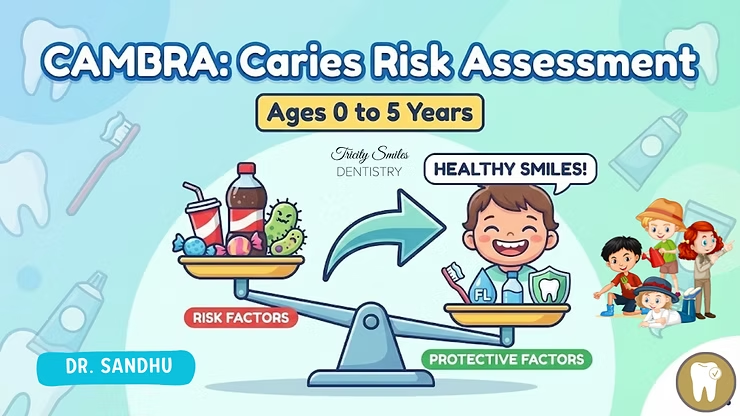
Caries Risk Assessment is a scientific method dentists use to predict how likely a child is to develop cavities based on diet, habits, bacteria, fluoride, oral hygiene, medical history, and more.
According to the AAPD, ADA, and WHO, dental caries is a multifactorial disease influenced by many factors. 3,4
Factors That Increase Cavity Risk
- 🍬 Sugar frequency
- 🪥 Oral hygiene habits
- 💧 Fluoride exposure
- 🦠 Bacterial levels (Streptococcus mutans)
- 👨👩👦 Parental oral health
- 🦷 Existing decay (strongest predictor)
- Socioeconomic & dietary patterns
- Saliva quality
What CRA Helps Us Do
✔ Detect high-risk children early
✔ Prevent Early Childhood Caries (ECC)
✔ Create a personalized prevention plan
✔ Decide fluoride frequency
✔ Guide diet and feeding habits
✔ Assess bacterial transmission within families
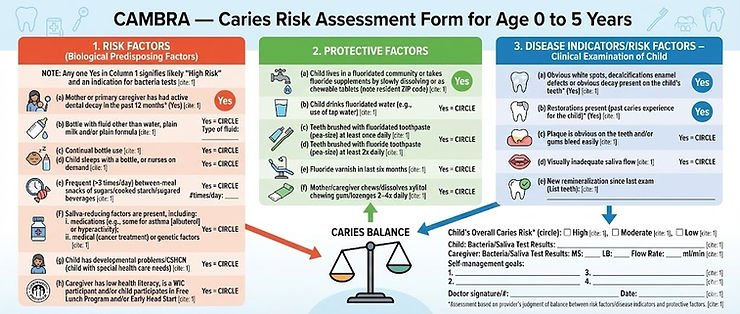
How Do Dentists Assess Caries Risk?
(AAPD & CAMBRA Framework)
1️⃣ Disease Indicators (Highest Weight)
| Existing cavities |
| White-spot lesions |
| Visible plaque accumulation |
| Cavities in the last 3 years |
| Tooth defects (enamel hypoplasia) |
Why this matters –Because past or current decay is the strongest predictor of future cavities.¹,²
2️⃣ Biological Risk Factors
These increase a child’s chances of developing cavities.
| Biological Risk Factor | Examples |
| High sugar frequency | Biscuits, chocolates, snacks |
| Night-time feeding | Bottle or breastfeeding without brushing |
| Sugary drinks | Juice, flavored milk, energy drinks, sodas |
| Low fluoride exposure | Non-fluoridated water, irregular brushing |
| Caregiver with cavities | “Sugar bugs” transfer from parents |
| Deep pits & grooves | Hard-to-clean teeth surfaces |
| Medications | Those causing dry mouth |
| Special healthcare needs | Higher risk overall |
| Premature birth | Weaker enamel |
Tricity-Specific Factors
- Biscuit-based snacks
- Packaged juices & flavored milk
- Processed toddler foods
- Limited community fluoride exposure
- Delayed first dental visit (very common in India)
3️⃣ Protective Factors (Lower Risk)
These reduce cavity risk and help balance harmful factors.
| Brushing twice daily with fluoride toothpaste |
| Parental supervision (until age 6–8) |
| Professional fluoride varnish |
| Sealants |
| Regular dental check-ups |
| Drinking fluoridated water |
| Healthy snack routine |
| Good saliva flow & hydration |
📊 How Dentists Classify Caries Risk
(Based on AAPD CRA Tool):
| Risk Level | Characteristics |
| Low Risk | No cavities, good oral hygiene, limited sugars, consistent fluoride, regular visits |
| Moderate Risk | White-spot lesions, occasional sugars, inconsistent brushing, limited fluoride, mild plaque |
| High Risk | Existing cavities, night-time feeding without brushing, frequent sugary snacks, low fluoride, caregiver decay, poor hygiene, medical conditions |
Most Indian children fall in moderate to high risk because of diet patterns and delayed dental visits.5
Why Caries Risk Assessment Is Critical for Indian Families
✔ Over 50% of Indian children have cavities by age 5 5
✔ Diets are rich in hidden sugars (biscuits, juices, flavored milk)
✔ Night-time feeding habits increase risk
✔ Delayed first dental visits allow early lesions to progress
✔ Fluoride exposure is inconsistent
CRA helps break this pattern through personalized prevention.
🏠 How to Prevent Cavities Based on Risk Level
🟢 Low Risk — At-Home Prevention
| Recommendations |
| Brush twice daily with fluoride toothpaste |
| Limit sticky snacks |
| Maintain 6-month dental visits |
🟡 Moderate Risk — At-Home Prevention
| Recommendations |
| Fluoride toothpaste (1000+ ppm)Supervised brushing |
| Limit sugars and rinse after snacking |
🔴 High Risk — At-Home Prevention
| Recommendations |
| Fluoride toothpaste (1000+ ppm) |
| Stop night feeding or brush afterStop sugar intake |
| Varnish every 3 months |
| Sealants (if needed) |
Professional Dental Care at Tricity Smiles Dentistry
We tailor prevention based on your child’s risk category:
✔ Caries Risk Assessment at every visit ✔ Early cavity detection ✔ Fluoride varnish (every 3–6 months) ✔ Sealants for deep grooves ✔ Diet & feeding counselling ✔ Saliva and habit assessment ✔ Personalized recall intervals (3, 6, or 12 months)
⭐ What Our Patients Say
The preventive approach is amazing. Instead of waiting for cavities to appear, we now have a clear plan to avoid them – Mrs. Preeti
About Dr. Sandhu & Tricity Smiles Dentistry
Dr. Sandhu is a US-trained dentist with 20+ years of experience, passionate about preventive dentistry and family-focused oral care.
At Tricity Smiles Dentistry, our mission is simple: ✨ Prevent problems before they start
✨ Provide gentle and personalized care
📍 House No. 109, Sector 28-A, Chandigarh
📞 +91-7686828000
🌐 https://www.tricitysmiles.in
📍 Google Maps: https://maps.app.goo.gl/WQGZKryUBPBN954F9
Preventing Cavities Starts With Understanding Risk And We’re Here To Guide You Every Step Of The Way
❓ FAQs
1. What is the biggest risk factor for cavities?
A history of cavities or early white-spot lesions is the strongest predictor.
2. At what age should risk assessment begin?
By age 1, or within 6 months of the first tooth.
3. Are cavities predictable?
Yes — with CRA, we can often prevent decay entirely.
4. Do genetics play a role?
They influence susceptibility but are not the main cause.
5. Can high-risk children stay cavity-free?
Absolutely — with consistent fluoride, brushing, and dental care.