


The short answer
Most children lose their first baby tooth, usually a lower front tooth, between 6 and 7 years old. The others follow in a fairly regular order, and the last baby back teeth usually go between 10 and 12. Ages vary from child to child. An adult tooth coming in behind a baby tooth is common and often settles by itself.
- Let a loose tooth come out on its own. Gentle wiggling is fine.
- If the adult tooth is through and the baby tooth is still firm after 2 to 3 weeks, book a check.
- A baby tooth lost early, through decay or a fall, may need a space maintainer to keep the gap open.
In what order do baby teeth fall out?
The front teeth usually go first and the back teeth last. The table puts the American Dental Association's published ages in the order most children follow.
| Baby tooth | Usually falls out | Adult tooth that replaces it | Usually comes in |
|---|---|---|---|
| Lower front teeth (central incisors) | 6 to 7 years | Lower central incisors | 6 to 7 years |
| Upper front teeth (central incisors) | 6 to 7 years | Upper central incisors | 7 to 8 years |
| Lower teeth beside the front teeth (lateral incisors) | 7 to 8 years | Lower lateral incisors | 7 to 8 years |
| Upper lateral incisors | 7 to 8 years | Upper lateral incisors | 8 to 9 years |
| First baby molars, upper and lower | 9 to 11 years | First premolars | 10 to 11 years (upper), 10 to 12 years (lower) |
| Lower canines (eye teeth) | 9 to 12 years | Lower canines | 9 to 10 years |
| Upper canines | 10 to 12 years | Upper canines | 11 to 12 years |
| Second baby molars, upper and lower | 10 to 12 years | Second premolars | 10 to 12 years (upper), 11 to 12 years (lower) |
Two things surprise many parents. The first adult molars, often called six-year molars, come in behind the last baby molars at about 6 to 7 years, and no baby tooth falls out to make room for them. They are permanent teeth, so they need careful brushing right to the back; our guide to brushing your child's teeth by age shows how. And new adult front teeth often look bigger and a shade more yellow than the baby teeth beside them, with small bumps along the biting edge. That is normal.
Is my child losing teeth too early or too late?
The ages in the table are typical ranges, and many healthy children sit a little outside them. Children whose baby teeth came in early often lose them early too.
If your child seems well ahead of or behind these ages, or has lost a tooth on one side and not the matching tooth on the other side, I would like to see them. An examination, and an X-ray where needed, shows whether the adult teeth are there and on their way.
How should I care for a loose baby tooth?
- Let your child wiggle it with a clean finger or the tongue. Health New Zealand's advice for an over-retained baby tooth is the same: gentle wiggling helps it come out.
- Keep brushing gently around it. The gum can be a little tender, but plaque left there makes it more so.
- Offer softer food on that side if chewing hurts.
- Do not pull a tooth that is still firmly attached, and skip the thread-and-door trick. Pulling too early hurts and can tear the gum.
- When the tooth comes out, a little bleeding is normal. Ask your child to bite on clean gauze or a folded cloth until it stops.
- If the gum is sore, ask us or your child's doctor which pain relief suits your child.
A tooth that becomes loose after a fall or a knock is different: that is an injury, and it should be seen soon. See our page on children's dental emergencies, or read what to do when a child breaks a tooth.
What if the adult tooth comes in behind the baby tooth?
Parents often call this shark teeth: a double row, usually at the lower front, where the new adult tooth comes through behind a baby tooth that has not yet fallen out.
It is common. The lower adult front teeth form behind the baby teeth, and normally they dissolve the baby tooth's roots as they come up. When the roots dissolve slowly, the new tooth appears before the old one has gone. Health New Zealand describes this as normal and not a cause for concern. In many children the baby tooth loosens and falls out by itself, and the tongue then guides the adult tooth forward into line.
Book a check if:
- the adult tooth is clearly through and the baby tooth is still firm, or is not getting looser, after 2 to 3 weeks
- the adult tooth is coming in well out of line
- the gum around the teeth is swollen, sore or bleeding
- it happens with the upper front teeth or the back teeth, which is less common and worth a look
If the baby tooth needs to come out, it is a short visit. The area is numbed first, and laughing gas is available for children who are anxious. Read more about taking out a baby tooth gently.
What if a baby tooth is lost too early?
A baby tooth can be lost years early through decay, an extraction or an accident. The American Academy of Pediatric Dentistry describes baby teeth as forming a path that the adult teeth follow, and that path matters most at the back of the mouth.
When a baby molar is lost before the adult tooth is ready, the teeth on either side can drift into the gap. The space shrinks, and the adult tooth may come in crowded or be blocked. A space maintainer, a small fixed band and wire loop, holds the gap open until the adult tooth arrives.
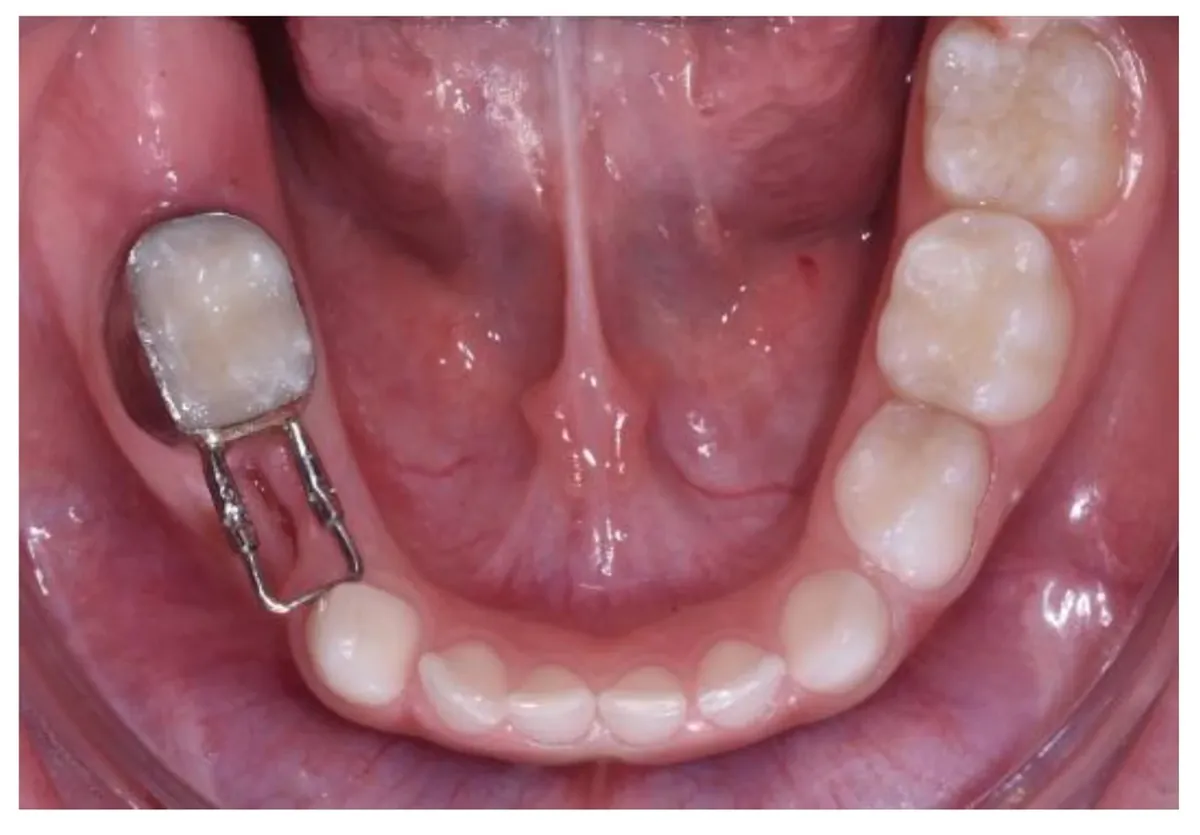
Not every early loss needs one. It depends on which tooth was lost, how close the adult tooth is to coming through, and how much space there is. A front baby tooth lost early usually matters less than a back one. Where a decayed baby tooth can still be saved, a root canal on a milk tooth keeps it in place until its natural time to fall out.
When should I bring my child in?
Regular check-ups catch most of these early. The American Academy of Pediatric Dentistry recommends a first dental visit by a child's first birthday, and at Tricity Smiles I lead children's dentistry for every age from first teeth to the last baby molars.
This article is general information and does not replace an examination. What is right for your child depends on their own teeth and health.