

The short answer
Most yellowing in adults is surface stain from tea, coffee, smoking, gutka or paan, often stuck to tartar, and a professional cleaning removes it. If the colour is inside the tooth, whitening lightens it. If the enamel is thin, chipped or marked from childhood, bonding or veneers cover it. An examination shows which one you have.
- Baking soda and charcoal can scrub at surface stain, but they cannot change the colour inside the tooth.
- Whitening does not change the colour of crowns, veneers or fillings.
- A dark spot that feels rough or catches floss may be a cavity rather than a stain.
Why are my teeth yellow?
Teeth turn yellow for three different reasons, and the colour can sit in three different places. Knowing which one you have tells you what will work.
| Where the colour is | What it usually looks like | Common causes | What helps |
|---|---|---|---|
| On the surface | Yellow or brown bands along the gums and between the teeth, often rough to the tongue | Tea, coffee, smoking, gutka, paan, khaini and other chewed tobacco, and tartar that holds the stain | A professional cleaning |
| Inside the tooth | An even yellow or grey colour across the whole tooth that brushing never shifts | Age, the natural shade you were born with, some medicines taken while the teeth were forming, too much fluoride in childhood, or a knock that damaged the nerve | Professional whitening, for most types |
| Thin or damaged enamel | Yellow showing through at the edges or near the gums, worn or chipped edges, or white and brown patches | Grinding, acidic food and drink, reflux, brushing too hard, or enamel that formed poorly in childhood | Bonding or veneers |
Under the white enamel is a layer called dentine, which is naturally yellow. When enamel wears thinner with age, grinding or acid, more of that yellow shows through. Many people have more than one cause at once: a tea drinker with some wear, for example, may see a clear change after a cleaning and still want whitening afterwards.
Will a cleaning remove yellow stains?
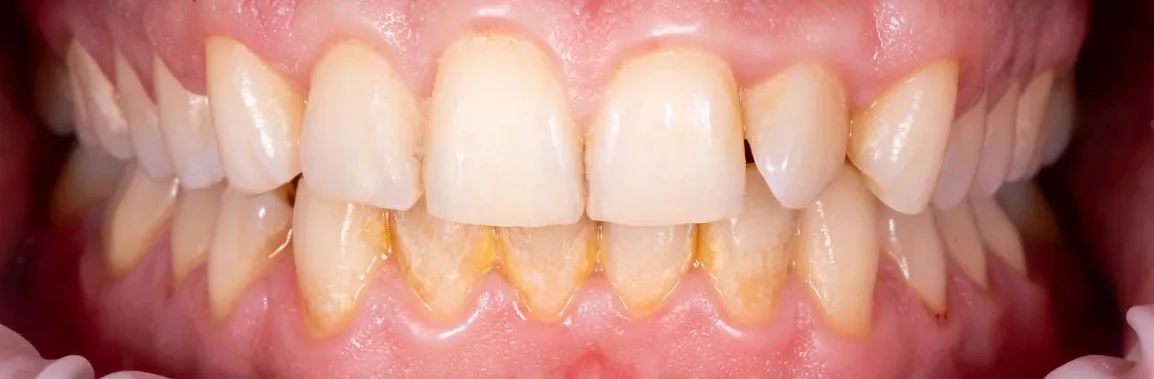
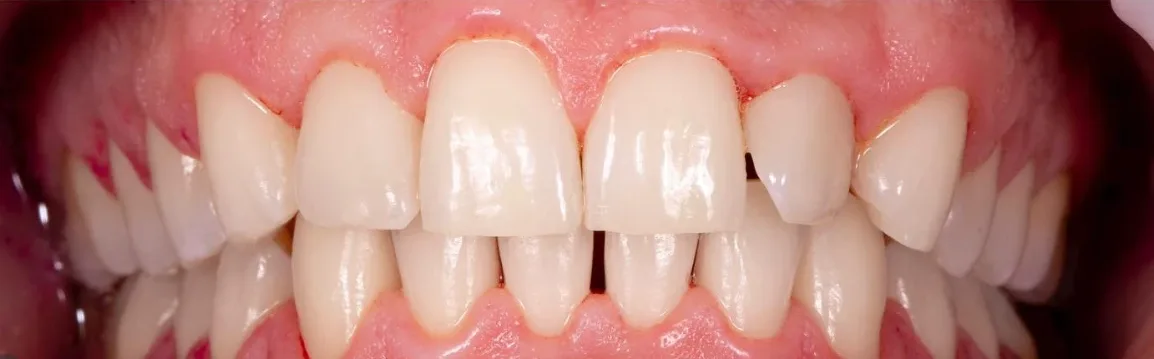
Yes, if the stain is on the surface. Tea, coffee and tobacco stain clings to plaque and to tartar, the hard deposit that forms when plaque is left on the teeth. Brushing at home cannot remove tartar once it has set.
At Tricity Smiles we clean teeth with Guided Biofilm Therapy (GBT). A harmless dye first shows where the plaque is, a fine air polish removes the plaque and stain, and an ultrasonic scaler takes off hardened tartar where it remains. The photos above show one patient before and after.
A cleaning removes what sits on the tooth. It does not lighten the tooth's natural colour, so if your teeth still look yellow once they are clean, the colour is inside the tooth.
When does teeth whitening help, and when does it not?
Whitening uses a peroxide gel that lightens the colour inside the enamel and dentine. It works on natural teeth whose colour has darkened with age, food and drink. The American Dental Association notes that whitening will not work on caps, veneers, crowns or fillings, or on discolouration caused by some medicines or an injury to the tooth.
A cleaning comes first, so the gel reaches the enamel evenly. If you are thinking about it, read how professional whitening works at the clinic, including which stains resist it. The NHS warns that whitening kits bought online or from salons may work less well and can harm the teeth and gums.
What if the enamel is thin, chipped or marked?
Whitening cannot replace lost enamel or hide a white or brown patch that formed in childhood. These teeth are covered instead.
- Bonding: a tooth-coloured composite is shaped onto the tooth to cover a small patch, chip or worn edge. No enamel, or very little, is removed.
- Veneers: thin porcelain shells bonded to the front of the teeth. They can cover stains that whitening cannot shift, such as fluorosis or tetracycline staining. A thin layer of enamel is reshaped first, so once a tooth has a veneer it will always need one. See veneers and smile design for how the result is planned digitally before any tooth is touched.
Do baking soda, charcoal or lemon remove stains?
Home methods work on the surface at most. Some can wear the enamel, and thinner enamel looks more yellow, so the result can be the opposite of what you wanted.
| Method | What it can do | What it cannot do |
|---|---|---|
| Baking soda | A mild abrasive that can lift some fresh surface stain | Change the colour inside the tooth or remove tartar. Scrubbing hard, or mixing it with salt or lemon, can wear enamel and irritate the gums |
| Charcoal powder or toothpaste | Scrub at surface stain | Whiten the tooth itself. A 2017 review in the Journal of the American Dental Association found too little evidence that charcoal products are safe or effective, and described charcoal as abrasive to teeth and gums |
| Lemon, vinegar or fruit peel | Nothing useful for colour | These are acids. They soften enamel and can leave teeth more yellow and more sensitive |
| Whitening toothpaste | Remove some surface stain with mild abrasives | Change the natural colour of the teeth |
An ordinary fluoride toothpaste, a soft brush used twice a day, and cleaning between the teeth do more to keep stain from building up than any home remedy.
Do tea, coffee, smoking and gutka stain teeth?
Yes. Tea and coffee leave a brown film that builds up, especially where tartar has formed. Tobacco tar is dark and stains quickly. Gutka, paan, khaini and supari leave a brown or black stain that often settles along the gums and in the grooves of the back teeth.
A cleaning removes this stain, and it comes back if the habit continues. Rinsing with water after tea or coffee and keeping up regular cleanings slows it down.
If you chew gutka, paan or tobacco, or smoke, the stain is the part you can see. The World Health Organization lists tobacco and areca nut (supari) among the leading causes of mouth cancer, and tobacco is a main risk factor for gum disease. When you come in for a cleaning we also look at the gums, cheeks and tongue. Nobody will lecture you. The NHS advises getting a mouth ulcer that lasts more than 3 weeks, or a red or white patch, checked by a doctor or dentist, even if it does not hurt.
Is a black spot a cavity or a stain?
It can be either, and the two can look alike. A few signs help, but an examination, and sometimes an X-ray, is the reliable way to tell.
| More likely a stain | More likely a cavity | |
|---|---|---|
| Where it is | Lines along the gums or in the grooves of several teeth | One spot on one tooth, or a dark shadow between two teeth |
| How it feels | Smooth | Rough or soft, or it catches floss or food |
| Over time | Stays the same, or comes off with a cleaning | Grows larger, or a chalky white edge appears around it |
| Symptoms | None | Twinges with sweets, cold or hot, although early decay often causes none |
Decay starts as a chalky white spot and darkens as it goes deeper. Our article on the stages of tooth decay shows how a cavity grows, and why catching it early means a smaller repair. A small cavity is usually fixed with a tooth-coloured filling in one visit. For children's teeth, see why a child's teeth turn yellow or brown.
When should I see a dentist about stained teeth?
This article is general information and does not replace an examination. What is right for you depends on your own teeth and health.